Our guide to the best diving in Vietnam
Vietnam is the most easterly of South-East Asia’s mainland countries.
Its entire eastern coastline faces the South China Sea, from the Gulf of Thailand in the south to the Gulf of Tonkin in the north. To the west, it borders Cambodia & Laos, while to the north it borders China.
The length of the country means that it spans different climates, with hot, tropical conditions in the south and more temperate conditions in the north. It has nearly 3500km of coastline with many beautiful bays and numerous small islands.
The best diving spots tend to be in the south & the east of the country where the seas are warmer.

Jarda Malek
Highlights


Best dive sites in Vietnam
Vietnam’s most famous and established diving area is around Nha Trang, about two-thirds of the way down the coast, close to its most easterly point. The Nha Trang area has beautiful beaches and islands, excellent tourist facilities and professional dive operators. Many of the dive sites are close-by and easily reached.
Diving consists of gentle fringing reefs, wall diving and pinnacles, with some interesting underwater topography. It is a very popular place to learn to dive. A little to the north, Whale Island is coming to be known as a nice diving spot, with deeper, slightly more challenging sites than Nha Trang & the chance to see some bigger marine life.
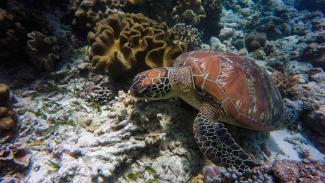
To the south, near the southern-most tip of the country is Con Dao. Situated 180km off the coast, it is blessed with excellent visibility and possibly Vietnam’s best diving. It is a nesting ground for both Green & Hawksbill Turtles and is also a sanctuary for Dugongs.
What marine life can you see diving Vietnam?
Common features of diving in Vietnam are lovely corals, colourful reef-fish, plenty of fascinating smaller critters and occasionally something bigger. The area is becoming increasingly renowned for its huge number and variety of nudibranch’s. For critter lovers, it is also possible to find Stonefish, Leaf Scorpionfish, Ribbon Eels, Frogfish, Seahorses & many Custaceans. Larger life includes Turtles, Stingrays, Eagle Rays, Bumphead Parrotfish & occasional visits from Whalesharks.
Ease of Travel
Travelling around Vietnam is relatively easy. International flights arrive at Hanoi, Ho Chi Minh or Da Nang. From there, you can travel by domestic flight, train or bus. There is a main train line running from Hanoi to Ho Chi Minh that is good value & comfortable. Book your ticket in advance though and make sure you know for sure what class you are travelling in. Buses fill in the gaps, with both private buses and public buses.
People
The 84 million people that call Vietnam home are generally extremely friendly & hospitable. They are proud of their country, which is no surprise when you learn of their history. Most Vietnamese consider themselves to be Buddhist, however they tend to have their own version of Buddhism that integrates many traditional belief structures. Vietnam is a very young country, with 65% of the population under 30.
Safey
Vietnam is generally a safe place to visit. Visitors need to be careful in cities and tourist areas of petty theft and scams, but taking the usual precautions should prevent too many problems. in certain rural areas, never explore away from well-trodden tracks. There are still undetonated explosives to be found that are a sad reminder of Vietnam’s painful past. This is not a problem in built up and well-travelled areas though.