
Enshadi
All the equipment involved in diving can seem a little intimidating to a newcomer. You are likely to be wondering what on earth a Regulator is, what BCD stands for, what a split fin might be & how many millimetres your wetsuit needs to be.
There's no need to feel intimidated though. Our beginner's guide to dive equipment will take you through the basics and help you feel a little more at home with some of the terminology.

Love marine life?


BCD's, tanks & regulators
BCD
BCD stands for Buoyancy Control Device. It is essentially an inflatable jacket. Add air to your BCD and you will be more buoyant in the water. take air out and you will be less buoyant. You will hear some BCD's referred to as integrated BCDs. This simply means that they have pockets where you can put your dive weights, instead of attaching them around your waist like a belt.
Regulator
A regulator is the most technical piece of your dive equipment. It attaches to your scuba tank, releasing air from the tank when you breath in and converting it to a pressure that is suitable for you to breath. The central part of a regulator is known as the first stage and attaches to your scuba tank. There are also four hoses: one that provides air for you, known as your second stage; a spare second stage for emergencies, often known as an Octopus; a hose that attaches to your BCD allowing you to add air to the jacket and a guage that tells you how much air is left in your scuba tank.
Scuba Tank
A scuba tank holds pressurised air that you will use during your dive. Normally, this air is pressurised to 200 bar (the air we breath at sea-level is 1 bar). Some places will measure the air pressure in PSI (pounds per square inch) rather than bar. This pressurised air is converted into air we can breath by the regulator. Scuba tanks are normally made of either steel or aluminium. They come in various sizes, but the most commonly used tank is 12 litres.


Mikaku
You might also enjoy...
Southern Andaman
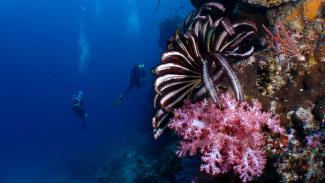
Thailand's southern Andaman sea boasts numerous beautiful islands & beaches, plus some great diving opportunities.
The southern Andaman region of Thailand is less developed than further north, offering a refreshingly relaxing alternative to the hustle & bustle of Phuket & even Ko Phi Phi.
Lombok & Gili Islands
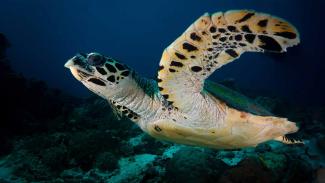
In north-west Lombok, the Indonesian island to the east of Bali, are three idyllic islands known collectively as the Gili Islands.
These small islands, as well as being beautiful above water, also offer a visual feast below the waves, with plenty of turtles & other great marine animals.
The islands, which have no cars and a very relaxed way of life, have become the most popular spot in Indonesia to learn to dive.
Underwater photography etiquette

Tara North
Underwater photography can be a absorbing hobby. Every avid underwater photographer has had moments so lost in his own world that they momentarily forget about everything else around them.
But we photographers have a responsibility to behave ourselves underwater and set a good example.
Find out how with our guide to photo etiquette...
Tioman & Aur
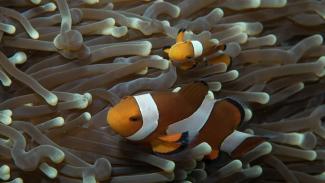
Around 40km off the east coast of Peninsular Malaysia, not far from Singapore is the picturesque island of Tioman.
A popular holiday resort for Malaysians & Singaporeans, the steep-sided jungle clad slopes of the island rise straight out the water and smaller islets dot the coastline, making for a spectacular tropical dive spot.
A little to the south is the tiny island of Aur, which while difficult to reach, has good diving.
Underwater housing care

Jakob Owens
Buying all the kit to allow you to take photos underwater is not cheap, so you need to make your equipment lasts the test of time.
One of the major and most vital expenses is your underwater housing. Housings are often fragile and can require a lot of care and attention though. So what should you be doing to look after your housing and to make sure it has a happy and healthy life?
Choosing the right dive spot

Phil North